Research in the midst of society
Setting up participatory research with a design component? 8D presents the Connecting Design & Research model, for both academic and societal impact.


A deck of cards is an excellent way to bring your research report to life and bring the knowledge gained to people in an engaging way. What to imagine with that? Get inspired by Care Trivia, an upbeat competitive card game about procurement of Wmo services. Our designers developed this game in collaboration with researchers at the Hanzehogeschool Groningen.




The Wmo, or Social Support Act, is a Dutch law that aims to support citizens in living independently at home and participating in society for as long as possible. Municipalities are responsible for implementing this law. They purchase care for their region to support residents in living and living independently. But how that procurement process can be handled in the best possible way is complex and far from clear to stakeholders.
Researchers Anneloes Scholing and Gepke Veenstra (Hanze University of Applied Sciences Groningen) mapped out the information needs among municipal officials dealing with the procurement of Wmo services. This led to the development of a handbook with in-depth information and tips on this topic. A great research result that deserved to be supplemented with an interactive work form: a card game!
 Approach
Our designers launched a Problem Storm. This is a session where we sit down with all stakeholders to frame the problem and map out the play context and frameworks. For example, should the game be playable independently, or will a game facilitator be present at each session? How much time is available for a play session? And in what setting will it be played? All these kinds of practical frameworks are important for game design. Moreover, thinking about these kinds of issues early on helps significantly in the implementation of the intervention. It forces both our designers and the collaborative partner to think carefully about the long term: how is this product actually going to be implemented, used and secured in the long term?
Some key frameworks that rolled out of the Problem Storm: the game should promote cooperation and mutual trust, be fun enough to take out again and again without guidance, and motivate players to dive into the handbook, where in-depth information on Wmo service delivery can be found. A smart choice. In general, independently playable games with a high entertainment content lend themselves best to learning in a broad sense, for example, stimulating a conversation about a particular topic or giving players an idea of the scope of the field in an approachable way. In this case, the scope of Wmo service delivery. Simplicity is key to the success of an independently playable educational game. And repetition – being fun enough to play over and over again – is, of course, great for actually perpetuating the knowledge that arises while playing.

“We chose a serious game so that our guide would not become just another report added to the pile. This invites people to engage with the topic in a different, more playful way.”

Lecturer-researcher at the Research Group for Sustainable Finance and Entrepreneurship


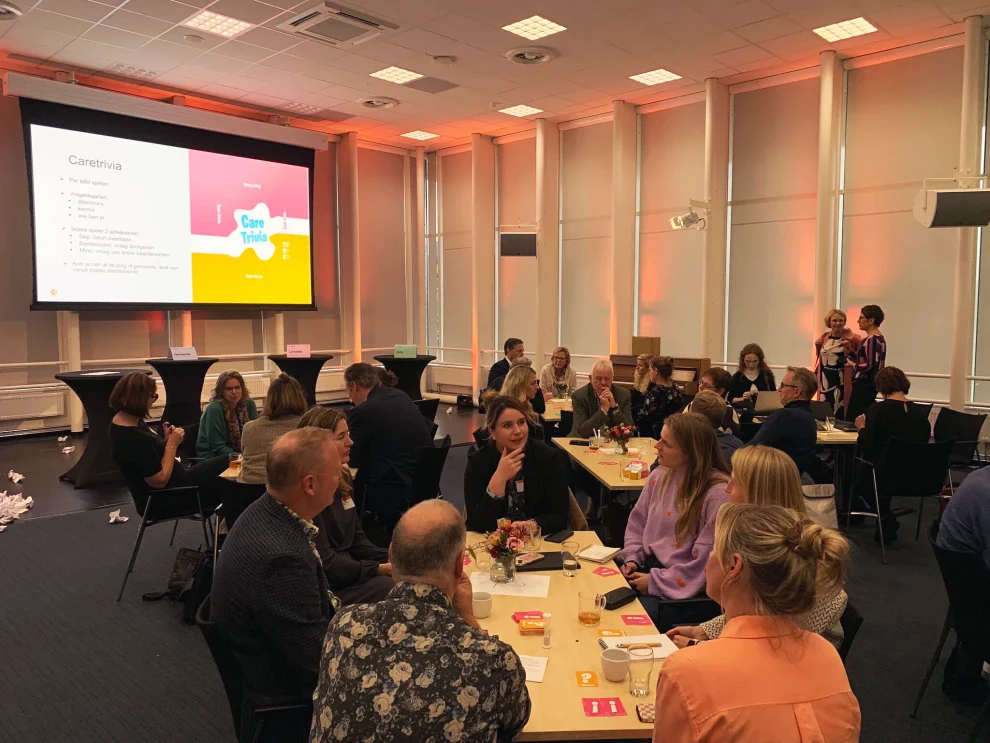


Photos: Hanze University Groningen & Edwin ten Wolde (8D)
 Results
Out of the four creative concepts, “Care Trivia” came out on top. The content of the game is based on themes surrounding the WMO procurement process and specific cases from the care sector, represented on trivia cards. The action cards add an element of surprise, allowing players to take or avoid questions. This makes strategic play possible, and hefty discussions can ensue. Who is right? If the players cannot agree among themselves, then the guide with in-depth information solution. This keeps the game challenging, interactive and does what it should do: get players actively involved with the valuable information from the research report of the Hanze University Groningen.
This project shows how to use a creative approach to communicate important learnings and research results to people and society in an interactive way. Would you also like to turn your research results into a tangible intervention? Feel free to get in touch.

Setting up participatory research with a design component? 8D presents the Connecting Design & Research model, for both academic and societal impact.
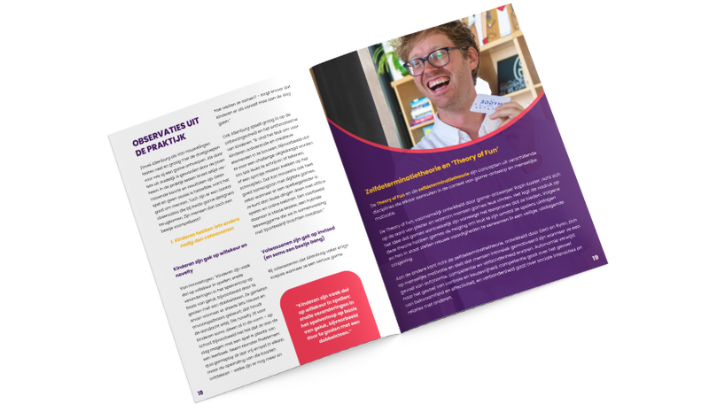
What is the relationship between serious gaming, science and psychology? And why is serious gaming really much more than a game anyway? This white paper is not about games, but about serious gaming as a scientific method for researching (social) tasks!
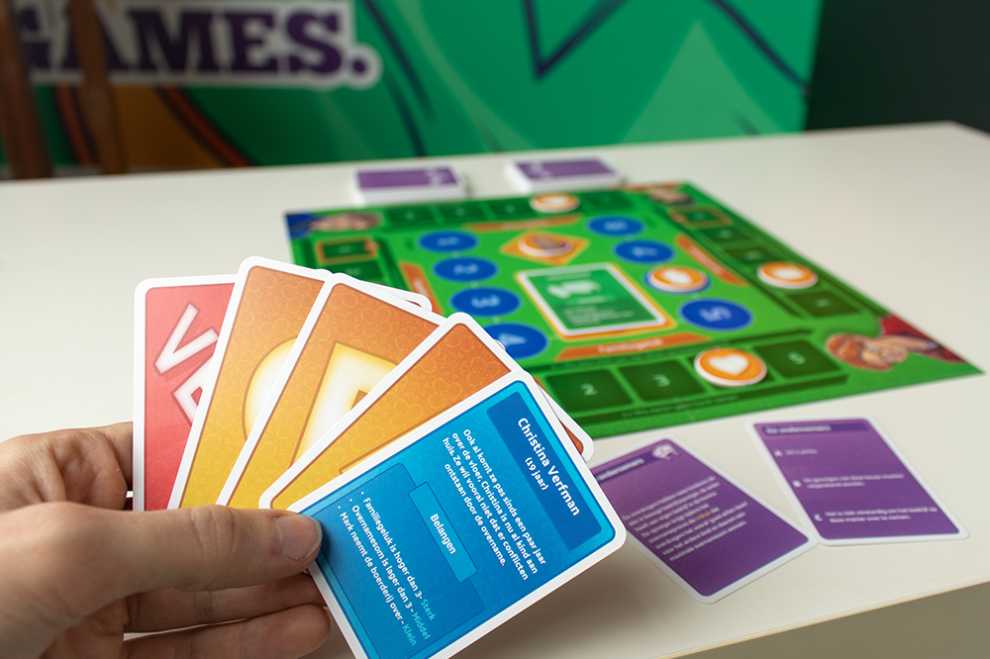
8D | Research + Design = Impact translates theoretical insights into offline interventions such as board, card, and role-playing games. This ensures knowledge doesn’t stay on paper but grows into meaningful change in practice.