On Design, Open Science and Knowledge Mobilisation
Open Science is the idea that scientific knowledge should be shared as openly, transparently, and reusably as possible. This does not only concern end results, such as a freely accessible article instead of a publication behind a paywall, but also openness about the process through which knowledge is produced.
That means, for example, that data, methods, code, and other building blocks of research are made available wherever possible. Other researchers, designers, and societal partners can then build on this or apply the knowledge and tools in their own practice.
On this page we explain how, in our view, Design and Open Science are connected. And above all, how we as designers commit ourselves to better disseminating and preserving “alternative outputs” of research, such as tools, creative products, and reports of co-creation, through the principles of Open Science.
What do Design and Open Science have to do with each other?
(Co-)design contributes to a core goal of Open Science
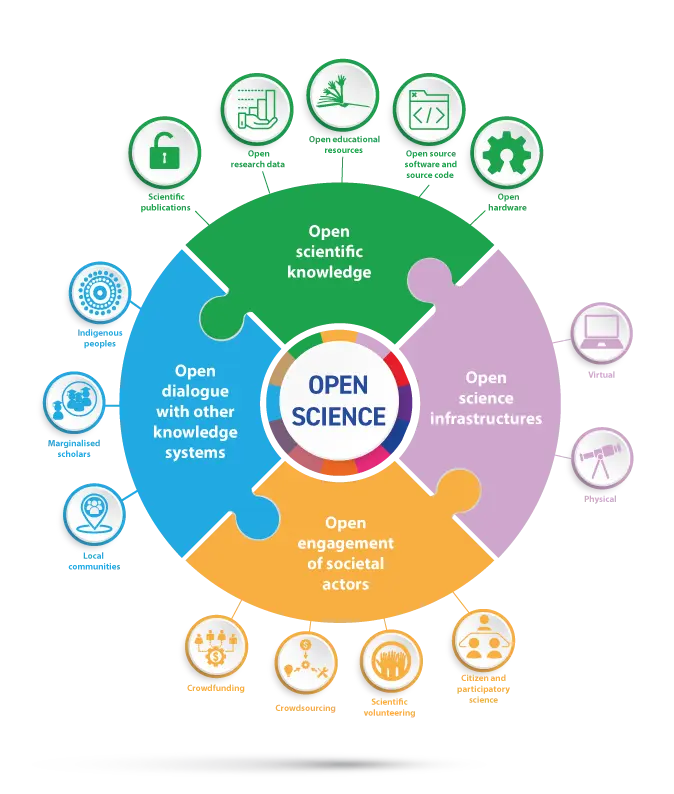
Open Science is often primarily associated with open access and open data: research outputs that are freely available to anyone who wants to consult them. However, in international frameworks such as the UNESCO Open Science Toolkit, the concept is explicitly defined more broadly. “Open dialogue with other knowledge systems” and “open engagement with society” are also identified as key characteristics of Open Science.
This is precisely the domain in which design and co-creation operate. When we work on artefacts such as games, websites, or interactive systems, we do so in collaboration with societal partners, citizens, and public authorities. In this process, different forms of knowledge come together and so-called alternative knowledge products emerge. These can take many forms and are at least as important as a scientific paper when it comes to making the impact of research visible.
2. Alternative outputs deserve a more explicit place
This brings us to the next point. These alternative outputs are generally documented and preserved far less systematically than traditional outputs such as scientific articles, let alone in line with Open Science guidelines.
As a result, important parts of a research project often disappear from view once the project ends. For example:
software underlying a publication cannot be found;; (Source)
design and co-creation processes are barely documented, often with the implicit conclusion that you had to be there to understand the impact.
This is not only a missed opportunity, it also places researchers in a difficult position. On the one hand, there is the desire, and often the pressure, to take research beyond academia and to collaborate with societal partners and citizens. On the other hand, within the academic ecosystem it is almost impossible to make the value of these kinds of alternative outputs visible. There are no established formats or working methods, and the outputs can take highly diverse forms.
For this reason, we actively explore in practice, and in dialogue with researchers, which forms of documentation are effective. Our aim is that by the end of a project, all aspects of the research are findable and remain accessible over time. This also requires us to be familiar with Open Science principles and to apply them consciously in our work.
What opportunities do you see to connect Design and Open Science?
During the design process
We see many opportunities to document and share the design process and the outcomes of co-creation. For example:
making design choices and assumptions explicit, for instance through memos or design documents;
recording observations and insights from user testing, such as designer field notes.
Where appropriate, we can ensure together that these materials receive their own DOI, making them citable and part of the academic ecosystem.
This makes it easier for researchers to combine co-creative work and product development with the need to produce sufficient academic outputs. We increasingly see researchers choosing, alongside their main research question, to also write a paper on the effects of co-creation on participants and or designers.
At the level of results
We are also keen to engage in dialogue about the accessibility of final outputs, for example by:
publishing software or designs under appropriate open licences;
contextualising artefacts so others can work with them, for instance through manuals, explanations of design files, or instructions for reproducing printed materials in another language.
“Designers ask practical and critical questions that researchers don’t always think of. It keeps projects grounded and prevents them from getting lost in abstraction.”
Professor Ineke van der Ham
Professor of Technological Innovations in Neuropsychology
Is everything you make always made publicly available?
No. Even if you fully support the principles of Open Science, of course there can still be well-founded reasons not to make publications or data openly available – for example due to privacy concerns, data sensitivity, or societal risks.
From an impact perspective, we add an additional consideration. Open Science does not automatically lead to greater knowledge utilisation or societal impact. In some cases, a final product or artefact has a better chance of being used sustainably when it is not made openly available. Making a product open access can also result in no one feeling real ownership, which removes incentives to develop a business case or to safeguard quality.
For us, Open Science is therefore not a dogma, but an instrument that needs to be applied thoughtfully. For each project, we make explicit choices together with researchers about who benefits from openness, which forms of reuse are desirable, and where protection or limitation is necessary. In doing so, we consider not only privacy and ethics, but also the expected impact of open versus restricted dissemination.
Are you a researcher with ideas about combining research, design and Open Science? We are would be glad to explore it together. Get in touch via nicole@8d.nl or johan@8d.nl to schedule a conversation.
Transdisciplinary research: challenges and recommendations
Expert interview
innovation
Transdisciplinary research brings together scientists and societal actors such as designers, artists, and policymakers to tackle complex issues. Examples include ethical dilemmas surrounding technology, climate adaptation, or healthcare innovation. Despite its potential, implementation remains challenging in practice: how do you ensure equal collaboration? How do you bridge differences in working methods and language? We discussed these questions with Julia Hermann, Assistant Professor in Philosophy and Ethics of Technology at the University of Twente.