International partnerships
Participation in European consortia increases your impact. Discover our role as a design partner in international collaborations and European programs, where we actively expand our network and initiate new projects.


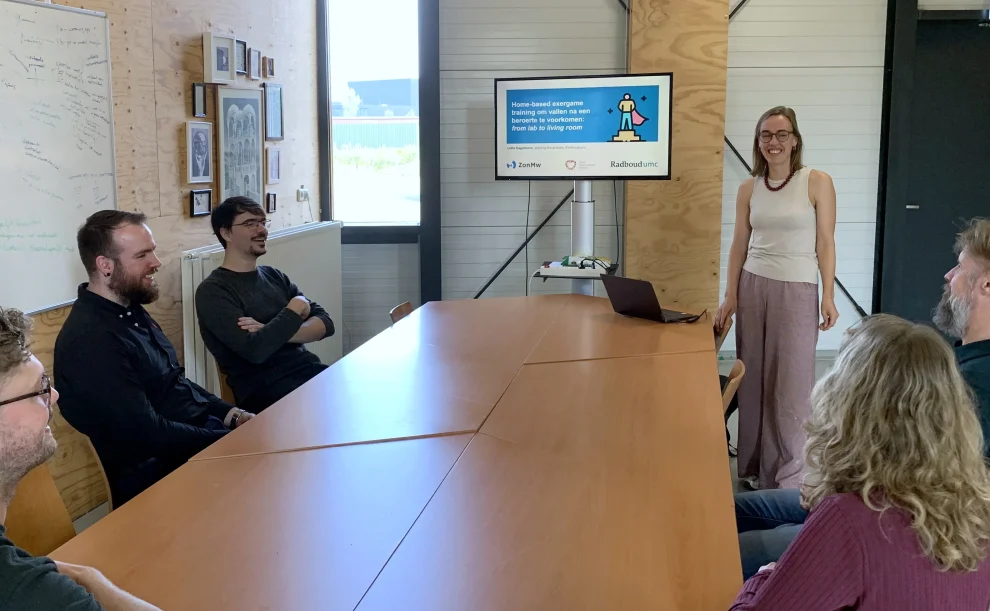
Recently, Lotte Hagedoorn (Radboudumc) gave our team a sneak preview of her research results with the HEROES game, a game for balance training after a stroke that patients can use at home. Her dissertation has been approved, and she will defend it on October 28, 2026.
That makes Lotte the eighth researcher to earn a PhD on research that 8D was able to contribute to with design and prototypes. And every time, we’re struck by how much courage it actually takes: reconciling an innovative approach with academic conventions that can be somewhat rigid, finding pragmatic solutions time and again to safeguard patient participation (it’s no coincidence that Lotte previously won the Patient Participation Award at the Dag van de Wetenschap), and on top of that, making sure that things actually change in practice while also collecting enough data to earn a PhD.
“Around 350,000 people in the Netherlands have had a stroke. They are at a much higher risk of falling, and poor balance is an important risk factor,” says Lotte Hagedoorn. “When we lose our balance in everyday life, we often take a recovery step to prevent a fall. People who have had a stroke often find this harder. Research has shown that these responses improve after a special training in which people are actually thrown off balance. This way, they can learn how to take a good step to prevent a fall. There are strong indications that this training can reduce the number of falls. However, the equipment needed is expensive and has limited availability in the Netherlands. On top of that, having to travel often and far for such training is a burden.”
That is why the HEROES (Home-based ExeRgaming fOr Enhancing resistance to falls after Stroke) consortium of Radboudumc and the University of Twente developed a training that patients can use independently at home. Patients first practice once with real balance perturbations at a rehabilitation center, and then continue training at home with the game prototype created by team 8D. In the game, titled ‘Heroes of the Sea’, the player is the captain of a raft. A model captain demonstrates the movements, and the player follows along by shifting their weight and taking steps. Fish and birds bumping into the raft virtually throw the player off balance, so the player practices exactly the recovery steps that can prevent a fall in everyday life. Lotte tested and studied this prototype in collaboration with six Dutch rehabilitation centers.
The hard results of the study, at least until the defense, aren’t ours to reveal. But we’d love to share a ‘soft’ outcome that we found really inspiring. Beforehand, there were understandable concerns about letting patients work with the game on their own. With the right instructions, though, it went well. Several participants even told Lotte that taking part in the study had boosted their self-confidence. As a Dutch saying goes, ‘vaak ben je te bang’: more often than not, we worry too much, and that seems to hold true in research every now and then as well. Caution is important, but it’s a balance worth guarding: underestimate your participants, and you may take away opportunities that could actually help them.
HEROES will continue as part of the ScaleUp4Rehab project, which aims to make rehabilitation therapy accessible to more patients.
Besides Lotte Hagedoorn, the HEROES research team consists of Vivian Weerdesteyn, Edwin van Asseldonk, Aurora Ruiz Rodríguez and Ilse Leijen (Radboudumc and the University of Twente). Industrial partners are Motek Medical and 8D. Participating centers are Revant medisch specialistische revalidatie, Amsterdam UMC, UMCG Centrum voor Revalidatie, Militair Revalidatie Centrum Aardenburg, Sint Maartenskliniek and Klimmendaal. The research was funded by ZonMw and the Dutch CardioVascular Alliance.
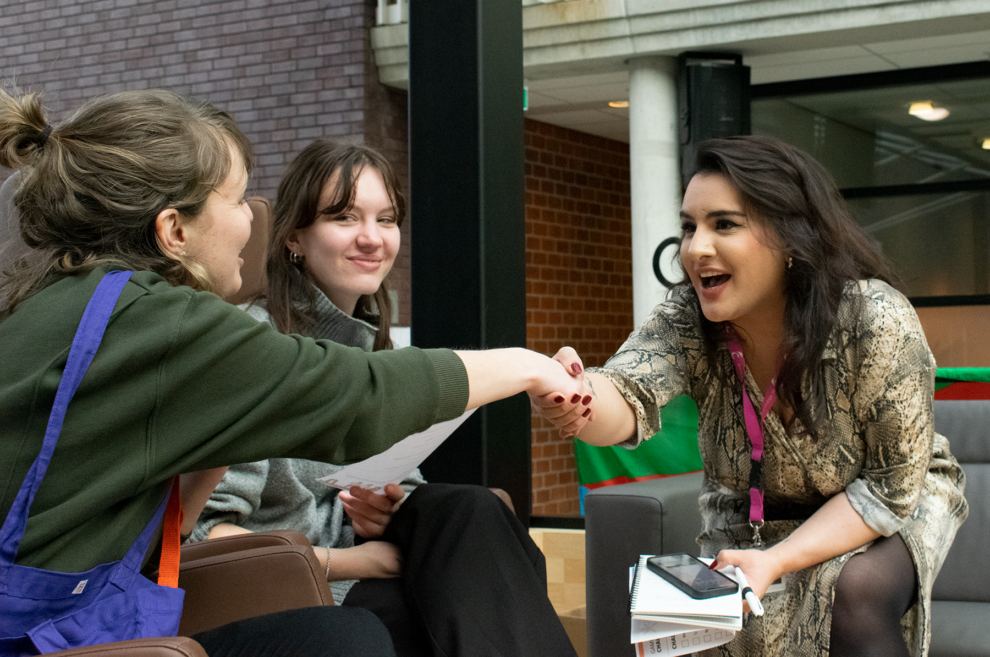
Participation in European consortia increases your impact. Discover our role as a design partner in international collaborations and European programs, where we actively expand our network and initiate new projects.
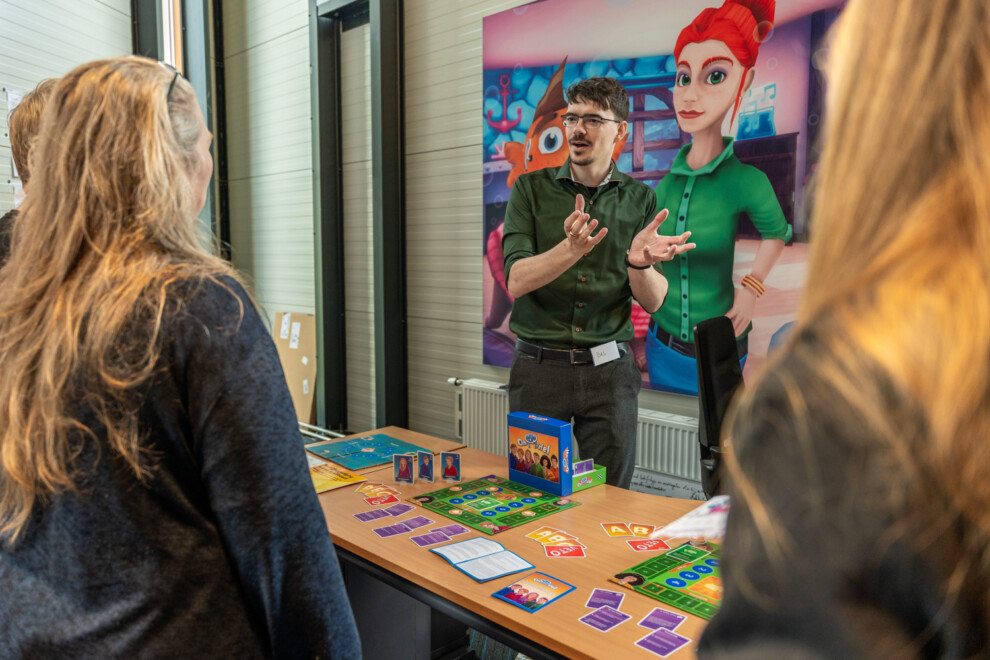
How can research findings be shared effectively with society? This article explores how participatory design supports effective knowledge transfer by aligning form, content and context. Real-world examples illustrate how design enhances the practical usability of academic insights.
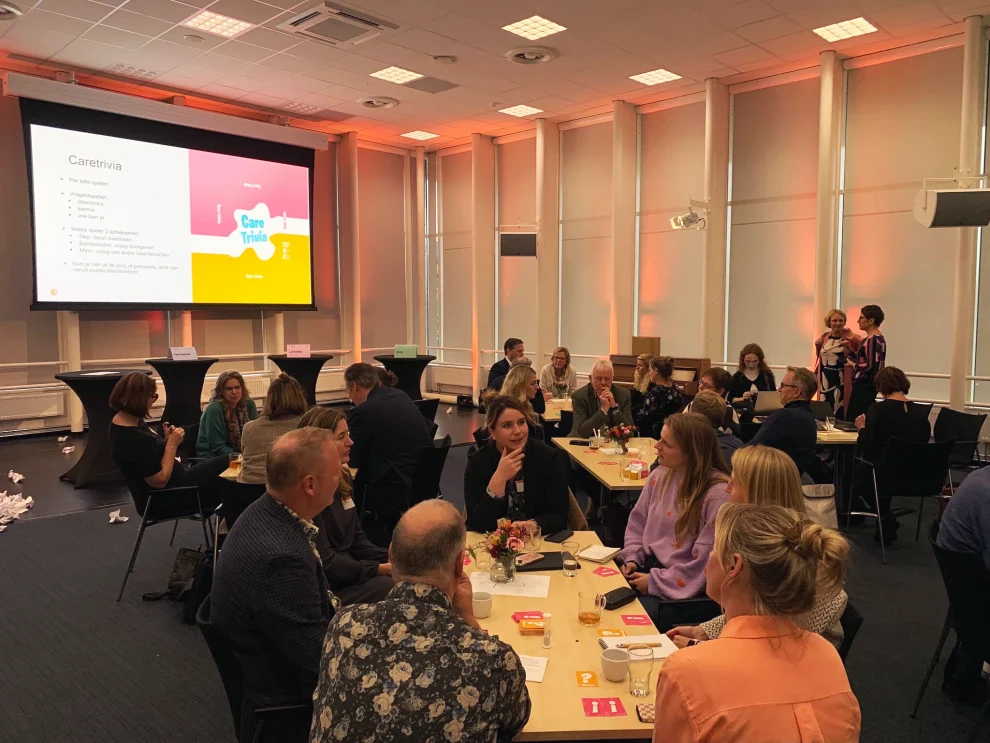
How do you disseminate research results in a way that truly lands in policy and practice? Our vision: dissemination is an integral and substantive part of the research process, not a box to tick at the end.