A practical tool for collaboration between researchers and designers
What is Connecting Design & Research?
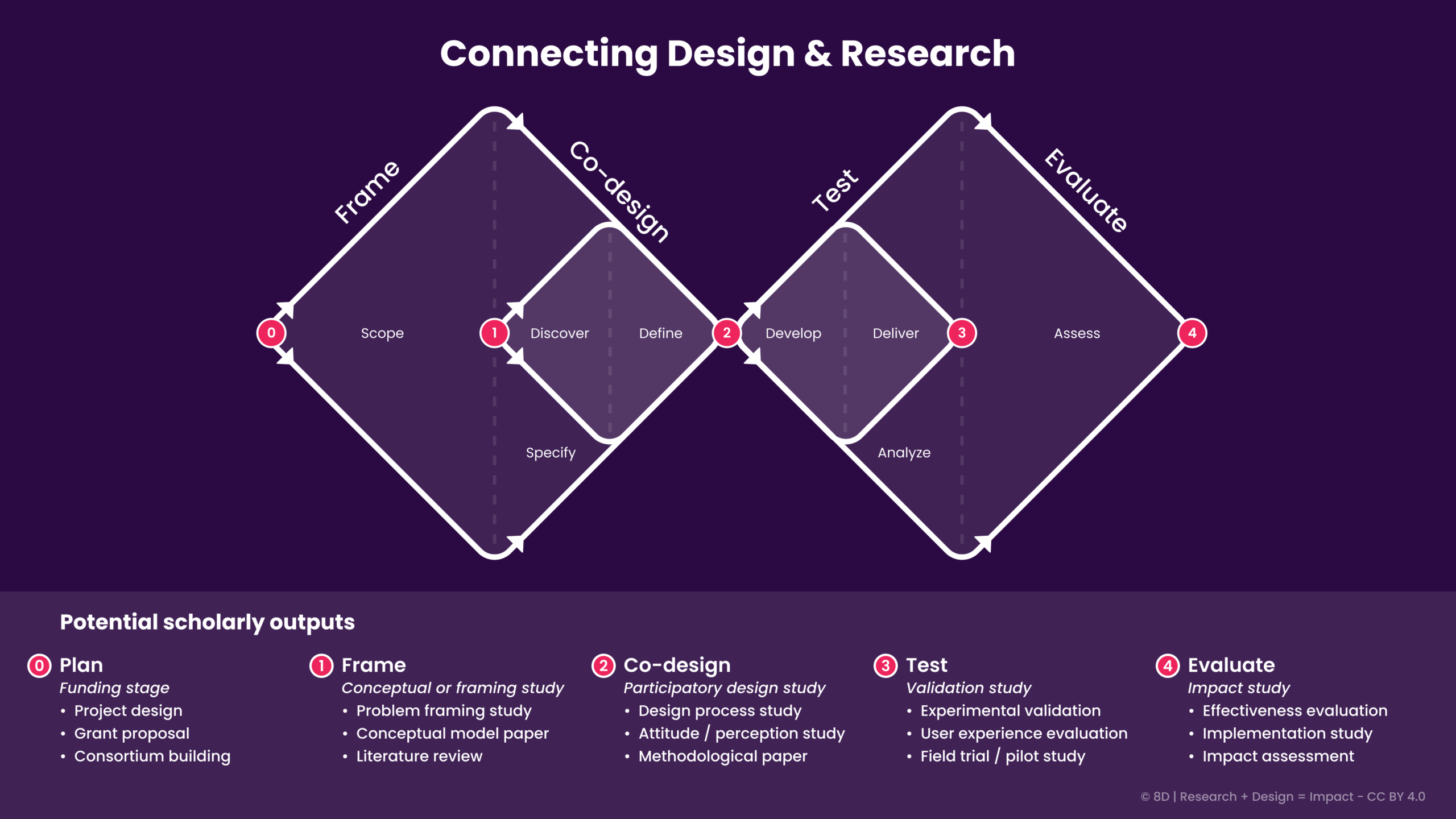
‘Connecting Design & Research’ is a practical model that helps researchers and designers align their work within a shared process. It connects research questions, design decisions and knowledge generation, enabling co-creation, product development and academic research to work together more effectively.
This model helps researchers and designers/developers to:
better align research and design
make more informed decisions during projects
connect co-creation to research goals
develop knowledge that is both practically and academically relevant
The model is particularly relevant for research projects in which design, co-creation and product development are combined.
What problem does this model solve?
In many research projects, researchers and designers collaborate on tools and interventions that are used in real-world contexts. This often involves co-creation with societal partners and citizens. It is a positive development, as it helps research connect more directly with practice.
At the same time, it is not always easy for researchers and designers to share a common understanding of the overall process. Researchers often approach us with a concrete request, such as: “can you create a video, website or game?” While this is a logical starting point, it says little about what is actually being studied, which decisions led up to it, or what pressures may be at play, such as publication requirements.
As a result, important questions can remain unspoken. Why this intervention? What are we actually investigating? What do we want to measure, and what kind of data do we need? If these questions are not addressed together, design choices and research goals can drift apart. This can lead to solutions that do not fully support the research, or to research that does not make the most of the design process and its practical context.
Over the past few years, we have increasingly made a point of asking about this context. We have found that this improves collaboration and, more importantly, leads to stronger impact, both academically and in practice. At the same time, it often took a lot of explanation to clarify why we were asking these questions. To make that conversation easier, we developed the Connecting Design & Research model. It offers a shared language for understanding how research and design relate within a single process. By making these connections visible, it helps both researchers and designers ask better questions, make more informed decisions, and align their work throughout the project.
Connecting research and design: preview and download the visual
The Connecting Design & Research model shows how research and design activities can be aligned within one process, from exploration to implementation.
Image Downloader
What the model illustrates
This model builds on the Double Diamond developed by the UK Design Council, a widely used framework that structures the design process into four phases: discover, define, develop and deliver.
We have extended this model with a research rhythm that runs across these phases: scope, specify, analyze, assess. This makes it easier to see how research activities and design steps relate to each other, and how decisions in one part of the process influence the others. For each phase, we provide examples of possible scholarly outputs. These are not exhaustive or prescriptive, but are intended as prompts to help identify where knowledge is generated and how it can be documented.
How to use this model
We primarily use this model as a conversation tool. In practice, it often leads to different kinds of questions. Instead of immediately focusing on a solution, the discussion shifts to the underlying research question and the purpose of an intervention. This helps teams make better decisions, both in the design and in how data is collected.
The model also helps maintain an overview throughout a project. It shows where you are in the process and which activities are relevant at that stage. This makes it easier to align work over time and to identify opportunities for knowledge development and publication at the right moment.
The model can be used, for example:
when briefing designers or developers
when developing a research design or project proposal
when aligning with consortium partners on roles and approach
during co-creation sessions, to stay focused on what is being studied and why
during evaluation moments, to reflect on where knowledge has been generated
Practical example
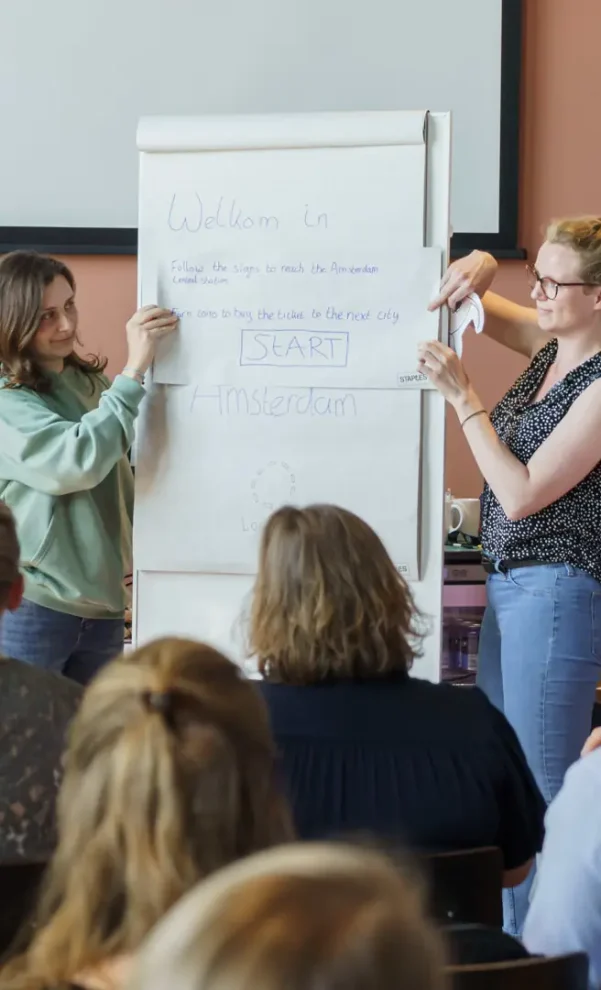
In a collaboration with the Trimbos Institute and Utrecht University, we were initially asked to develop an intervention in the form of an educational, playful pathway. While this request provided clear insight into the desired intervention (develop), it did not yet clarify exactly what was being investigated.
By using the model in the conversation, we gained a clearer understanding of the underlying research question: how motivation develops within a co-creation process. With that insight, we were able to more explicitly connect our design choices and the setup of the co-creation sessions to what was being investigated (define/analyze).
This led to a different approach for the workshops. We chose a set-up that would not only be in line with the participants’ experiences and product development, but could also contribute to the research.